Blue-Yellow Color Blind Test
Tap the number you see in the dots.
Remove tinted or color-enhancing glasses, turn off night mode and color filters, and use full brightness.
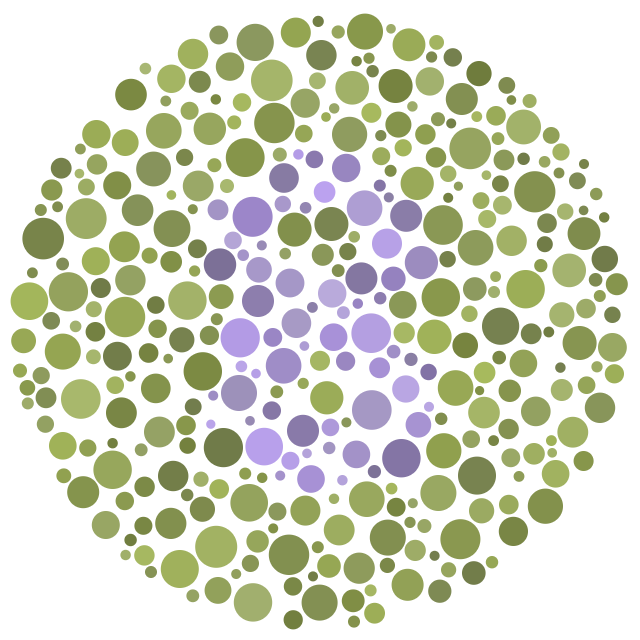
What number do you see?
Your quiz result
Matching every plate does not prove normal color vision, and missing plates does not prove color blindness.
Screen calibration, brightness, color filters, and lighting can affect what you see. This quiz is for curiosity and learning only. It is not a medical test and cannot diagnose or rule out color vision deficiency.
Not for job, school, military, licensing, or pilot screening. Those require an approved test given in person. The FAA does not accept home tests.
If your color vision has changed recently or looks different in each eye, see an eye doctor soon. Eye disease, other health conditions and some medicines can change color vision.
Which colors may be hard to tell apart?
Blue-yellow color vision deficiency can affect several color pairs. With tritanomaly, blues and greens can be hard to distinguish, as can yellows and reds. With tritanopia, blues and greens, purples and reds, or yellows and pinks can be hard to distinguish. National Eye Institute on blue-yellow color vision deficiency.
Why these plates use tritan lines
Our plates borrow an idea from Regan, Reffin & Mollon (1994). This is not the Cambridge Colour Test: it uses 3 fixed plates on an uncalibrated screen and has not been checked against clinical tests.
Each of this quiz’s three plates uses a different line through the tritan convergence point at (0.171, 0). The lines pass through several hues, and the result counts the digits you matched.
From a tritan line to a dot
One plate starts at B = (0.3127, 0.329) in the CIE diagram and uses the tritan convergence point P = (0.171, 0). Moving 23% of the way toward that point gives (x, y) = (0.280109, 0.25333). Assigning that dot relative luminance Y = 0.32 gives #A291C8 using the W3C conversion code. See the quiz’s full plate formula.