Red-Green Color Blind Test
Tap the number you see in the dots.
Remove tinted or color-enhancing glasses, turn off night mode and color filters, and use full brightness.
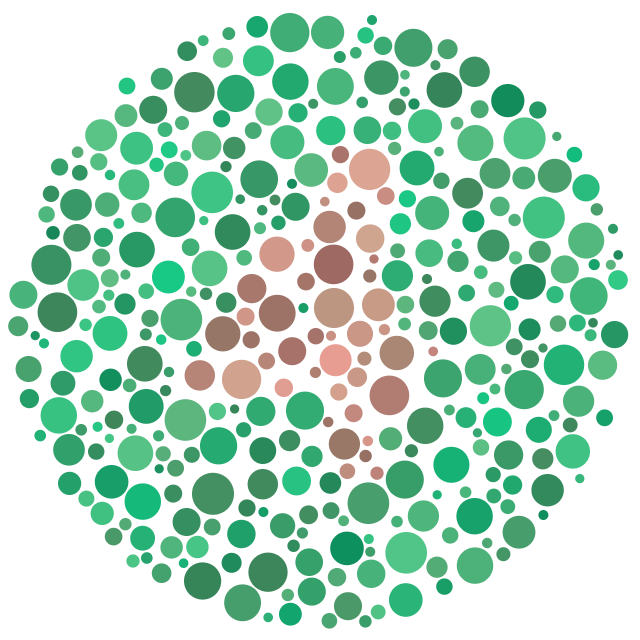
What number do you see?
Your quiz result
Matching every plate does not prove normal color vision, and missing plates does not prove color blindness.
Screen calibration, brightness, color filters, and lighting can affect what you see. This quiz is for curiosity and learning only. It is not a medical test and cannot diagnose or rule out color vision deficiency.
Not for job, school, military, licensing, or pilot screening. Those require an approved test given in person. The FAA does not accept home tests.
If your color vision has changed recently or looks different in each eye, see an eye doctor soon. Eye disease, other health conditions and some medicines can change color vision.
What red-green refers to
Red-green color vision deficiency is the most common group. Protanomaly can make some reds appear greener and dimmer. Deuteranomaly, the most common red-green form, can make some greens appear redder. Protanopia and deuteranopia can make reds and greens very difficult to tell apart. National Eye Institute on red-green color vision deficiency.
How the six plates work
Our plates borrow an idea from Regan, Reffin & Mollon (1994). This is not the Cambridge Colour Test: it uses 6 fixed plates on an uncalibrated screen and has not been checked against clinical tests.
This quiz uses three protan and three deutan lines, with varied dot brightness in both the digit and background. Your result counts the digits you matched. For a clinical assessment of color vision, see an eye-care professional. National Eye Institute on clinical color vision tests.
From a deutan line to a dot
Start from the base chromaticity B = (0.335, 0.370) and take t = 0.045 of the way toward the deutan convergence point P = (1.4, −0.4). Using C(t) = B + t(P − B) gives (x, y) = (0.382925, 0.33535). At relative luminance Y = 0.32, the XYZ-to-sRGB conversion gives bytes (197, 139, 134), or #C58B86, using the W3C conversion code. See the quiz’s full plate formula.